Nonlinear optics in hollow-core microstructured fibres
Funded by: Industry, EPSRC, ERC
Nonlinear optics in gas-filled hollow-core microstructured fibres
Microstructured hollow-core fibres, such as anti-resonant guiding fibre, provide a versatile platform for ultrafast experiments, enabling the enhancement of nonlinear effects in gases at high intensity (far beyond the damage threshold of solids) due to tight light confinement over long interaction lengths, with excellent output beam quality. Fine control of the dispersive and nonlinear system properties can be achieved by tailoring the fibre dimensions (core size and length) and by filling the core with gas at an appropriate pressure.
These properties can be exploited for broadband supercontinuum generation, for frequency up-conversion to the ultraviolet when driven by soliton dynamics or four-wave mixing processes, and for flexible on-target delivery of intense near-infrared laser pulses without distortion.
We are currently exploring many of these techniques, with a particular aim of moving this technology outside of research laboratories and into real-world applications, especially in the semiconductor and healthcare sectors.
Ultrabroadband Raman comb-to-continuum
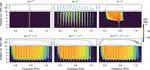
Although the generation of Raman frequency combs in gas-filled antiresonant fibres has been studied for many years, the process has only rarely been used for supercontinuum generation (which usually occurs through other mechanisms). In 2022 we demonstrated a new regime of supercontinuum generation which exploits the extreme bandwidth of vibrational frequency combs in gas-filled fibres in combination with high-peak-power picosecond pulses to create an exceptionally flat continuum covering the deep ultraviolet to the infrared.
.](/project/hcpcf/raman_hu_55e0b034fba97303.webp)
We have explored this process in a number of different gases and studied gain-suppression effects as well as supercontinuum generation in methane. We are also working on scaling this approach to megahertz repetition rate.
Low-threshold resonant dispersive wave emission
In parallel to the HISOL concept, which is concerned with energy up-scaling of optical soliton dynamics, we are also working on the opposite: extremely low-energy ultrafast sources in the visible and ultraviolet powered by just a few nanojoules of near‑infrared or visible light. By exploiting the same soliton and dispersive‑wave physics in gas‑filled hollow‑core fibres, but in a very small‑mode‑area geometry and at high gas pressure, it is possible to trigger frequency conversion to the deep‑UV with threshold energies below 50 nJ.
](/project/hcpcf/njUV_hu_c3d6e323152e7ba9.webp)
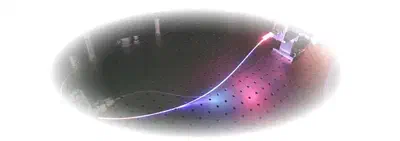
This approach enables resonant dispersive wave emission driven by low-energy short-pulse fibre lasers, such as our own home-built gain-managed amplification systems built by Mohammed Sabbah. So far, we have demonstrated sub-20-fs, megawatt peak power visible pulses generated directly from an all-fibre source.
](/project/hcpcf/fibrelaser_hu_6ba2b0f2e2e2ba0c.webp)
Much of our work in antiresonant fibres is enabled by a long-running close collaboration with the Centre for Photonics and Photonic Materials at the University of Bath.